Salmon in the Classroom: Overcoming Challenges in Rural Alaska
This article was originally published in the Copper River Record on February 26, 2026
Copper River Watershed Project – Press Release
Delivering hands-on educational experiences to youth in rural Alaska has its challenges: remote locations, vast distances to travel, fewer people on the ground to help facilitate… and weather. Programs like Salmon in the Classroom only happen because of generous supporters and a dedicated team of partners and participants who are willing to adapt and persevere through unpredictable conditions.
On Thursday, January 15th, those challenges were on full display. Robert Unger, Hatchery Manager with Valdez Fisheries Development Association (VFDA), was ready to divvy up salmon eggs scheduled for delivery to classroom tanks in the Basin the following day. At the same time, Robin Mayo from the Wrangell Institute of Science and Environment (WISE) was searching for someone to help transport the eggs to schools, coordinating an egg hand-off at the Pippin Lake Pullout when word came that an avalanche tumbled down the slope in Thompson Pass, blocking the Richardson Highway, forcing a road closure from Milepost 12 to 46.
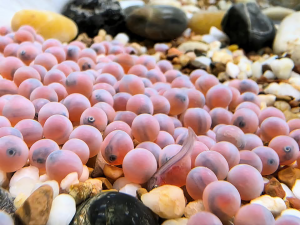
Timing is important when transporting salmon eggs, explained Unger. Eggs must be in the “eyed” stage before they can be safely moved, as they are more resilient to handling at that point. Transporting them too early increases the risk of damage, while moving them too late can result in premature hatching.
With the highway buried in snow and impassable, it gave new meaning to the term ‘fish passage barrier’. Usually, we think of damaged or undersized culverts blocking streams, not avalanches blocking the transport road for coho eggs heading upriver to classroom tanks!
Pivoting to alternatives, the team floated the idea of using Express Mail or UPS. While that can work under certain conditions, winter temperatures in our region make it risky. Unger said that drastic temperature changes, such as moving eggs from a 70-degree shipping room out into a vehicle in below-zero temperatures, can damage them.
The only good option was to wait until the road was clear to transport the salmon eggs, which finally happened on Thursday, January 22nd, after snow was removed, and the highway through Thompson Pass was again open for travel.
During transport, the eggs were kept cool in insulated containers with an ice pack and wrapped in damp cotton cloths. This creates a humid environment that allows the eggs to ‘breathe’ and exchange oxygen through their cell membranes. Careful not to expose them to rapid temperature swings, and keeping them relatively close to their ambient water temperature, the transit team moved the eyed eggs safely from Valdez to the Basin.
After the week-long delay, the eggs enjoyed what Mayo jokingly described on social media as a “little weekend vacation” in the Kenny Lake School tank before continuing on to Glennallen the following Monday.
Getting salmon eggs to classroom tanks is only one part of the journey. The process begins long before that, with supporters donating to purchase tanks and supplies, making Salmon in the Classroom possible. It’s a team effort, and this year the Copper River Watershed Project is thrilled to contract with the Wrangell Institute of Science and Environment (WISE) and the Ahtna Intertribal Resource Commission (AITRC) to sustain this program in our local schools, and help support our partners who are critical boots on the ground.
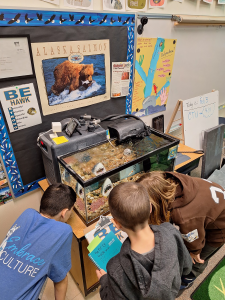
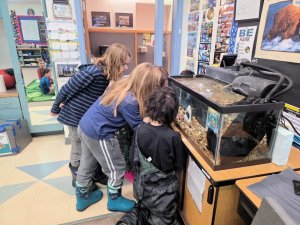
According to Mayo, one of the biggest challenges—aside from the avalanche—was setting up the classroom tanks. She credits Bailey Roberts, Education and Outreach Coordinator at AITRC, for finding all the tank parts and then spending countless hours puzzling through how to set them up properly. Each tank requires three fully functioning components: chilling, filtration, and aeration. “That’s a lot of tubes!” Mayo said.
Students and teachers handle daily tank maintenance, while Mayo and Roberts visit weekly to ensure everything is running smoothly and to support ongoing salmon education.
Is all of this effort worth it? In the Copper River region, life is deeply connected to salmon. Raising baby salmon gives students an up-close, hands-on understanding of what it takes for salmon to survive – or not – and what stewardship truly means.
In Glennallen, fourth graders enthusiastically discussed naming and tracking the fry. “They especially wanted to name one ‘Bob,’” Mayo said. Students also learn that not all eggs survive, gaining firsthand insight into the balance and realities of nature.
Thanks to determined partners and generous supporters, the way opened in time for these coho eggs to reach classroom tanks safely. Now they continue their journey with students in Glennallen and Kenny Lake, who will care for them until their release into local waters this spring. And hopefully, the avalanche in January is the only fish passage barrier they will ever experience.
You can find more information about salmon tanks and other stewardship initiatives at copperriver.org.